
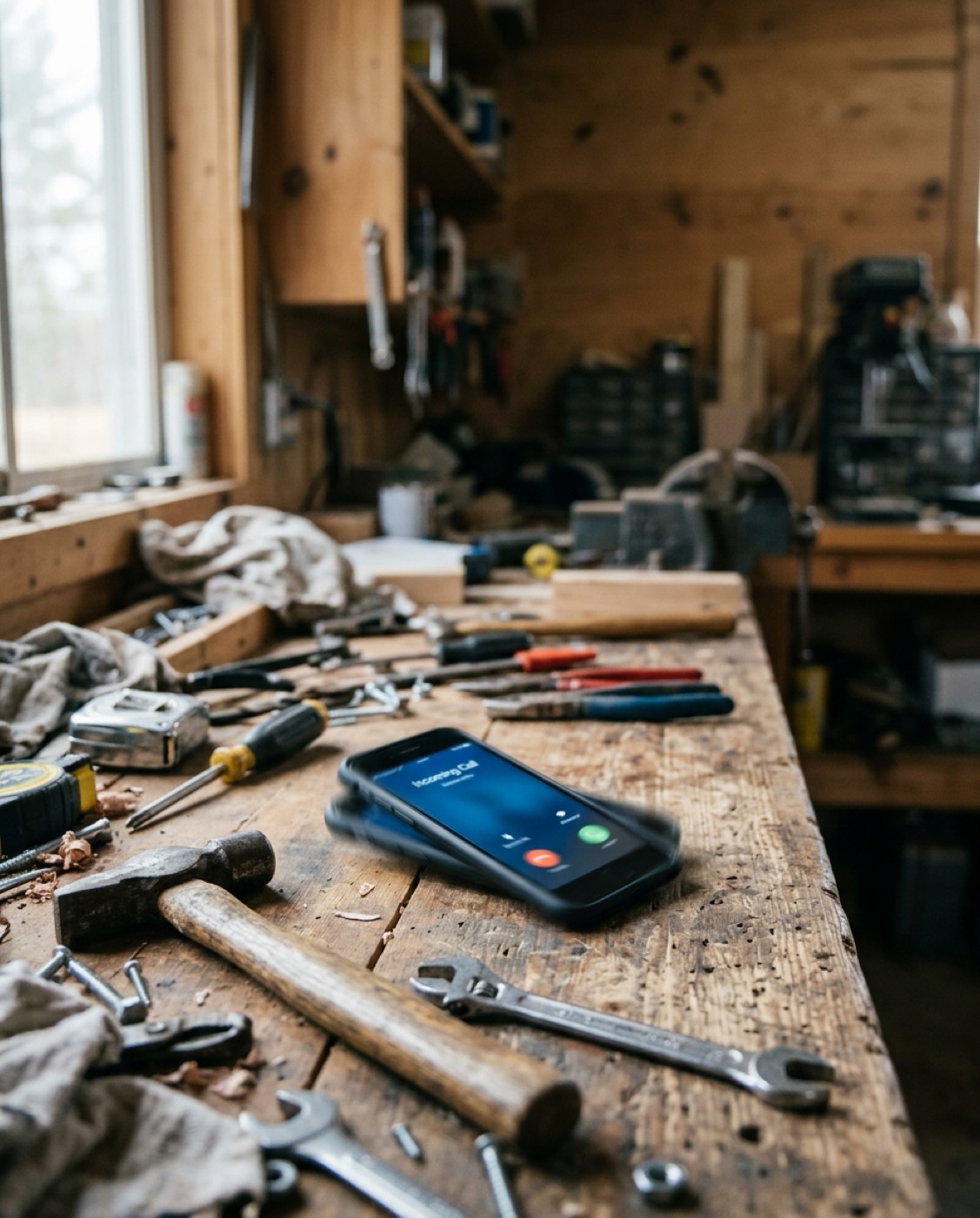
In one sentence: An AI receptionist is software that answers your business phone in a natural voice, holds a real conversation with the caller, collects what you need to know, and either books the job on your calendar or hands the call to a person, every time the phone rings, including the times nobody in your shop can pick up.
The other pages on this site are about being found by an AI. This one is about what happens after you are found, when the customer calls. It is the same story from the other end of the line.
What is it, in plain terms?
Think of the best front-desk person you have ever had. They pick up on the first ring. They know your services, your service area, your hours, what you charge for a service call and what you do not do. They ask the right questions in the right order, write it all down correctly, and put the appointment on the calendar. They are as sharp at 9 p.m. on a Saturday as at 9 a.m. on a Tuesday.
An AI receptionist is software built to do that specific job. It is made of three parts working together in real time: a speech system that turns the caller’s voice into text and the reply back into voice; a language model that understands what the caller means and decides what to say; and a set of connections to your tools, your calendar, your job-tracking software, your text messaging, so it can act, not just talk.
You configure it once with the facts of your business. After that, it answers.
What actually happens on a call?
Let me walk through one, because the sequence is what makes it real.
It is 7:40 on a Tuesday evening. A homeowner in Elk Grove has water coming out from under her water heater. She searches, or asks an AI, and calls the plumber it named. Everyone at the shop went home at 5.
The ring. The AI picks up on the first or second ring. It says the business name and asks how it can help, in a voice that sounds like a person and does not sound like a menu.
The listening. She says her water heater is leaking from the bottom and she wants it handled tonight. The AI understands that this is a water heater, that it is a leak, that it is active, and that the caller wants it handled tonight. It does not ask her to press a number.
The right questions. It asks the questions you told it to ask, in the order a good dispatcher would: Is the water shut off? Where in Elk Grove? Gas or electric? Is this a home you own? It might tell her where the shutoff valve usually is, if you configured it to.
The decision. Based on your rules, it decides this is a same-day job. It checks your real calendar, finds the 8 a.m. slot tomorrow, and offers it. She takes it.
The booking. It puts the appointment on your calendar with her name, address, phone, the problem and the answers to every question. It texts her a confirmation. It creates the job in whatever software your techs use in the morning.
The handoff, if needed. If she had said “there is water pouring through the ceiling,” the rules you set might say: text the on-call tech immediately and offer to connect the call live. The AI does that too.
The record. You wake up to a transcript, a summary, and a booked job. Not a voicemail.
From her side, someone answered, understood, and solved it.
Why does answering fast matter so much?
Because the customer is deciding in real time, and the clock is short.
75% of consumers choose a local business within 30 minutes of starting to look, and 28% within five minutes. 72% consider three or fewer businesses.[1] The homeowner with the leak is not building a spreadsheet. She calls the first name, and if nobody answers, she calls the second.
The effect of speed on whether a lead turns into a customer has been measured directly. In a study of more than 15,000 leads and 100,000 call attempts across six companies over three years, the odds of qualifying a lead dropped fourfold when response time went from 5 minutes to 10 minutes, and 21-fold when it went from 5 minutes to 30 minutes.[2]
Read that alongside the AI-visibility page. An AI that names you sent a customer who is ready to book. If the phone goes to voicemail, that customer calls the next name the AI gave her. The receptionist is the part of the system that catches what the visibility work produced.
What does “books the job” actually mean?
This phrase gets used loosely, so here is what it should mean, and what to check for.
It reads your real calendar. Not a copy, not a form that emails you. It sees the actual open slots on the schedule your techs work from, and it only offers those.
It writes to your real calendar. The appointment appears where your dispatcher would have put it, with the details filled in.
It creates the job record. In your job software, if you have one, so the tech’s tablet shows the address and the problem in the morning.
It confirms with the customer. A text or email with the time, so she stops calling other plumbers.
It follows your rules for what it may book. You decide: it can book a water heater diagnostic but must hand off a re-pipe estimate to a person; it can book weekdays but must text you for Sunday emergencies; it quotes the service call fee but never quotes a repair.
If a product “books the job” by sending you a message that says “customer wants an appointment,” it is a message-taker, not a receptionist. The difference is whether the customer hangs up with a time or with a promise of a callback.
What can it not do?
This section matters as much as the rest, because an owner who expects too much will be disappointed, and one who expects too little will not use it.
It cannot diagnose. It can ask the questions you gave it and route based on the answers. It should not tell a caller what is wrong with their furnace. Configure it to be clear about that.
It cannot quote a repair. It can state a fixed price you gave it (the diagnostic fee, the after-hours rate). It cannot look at a job and price it. If a caller pushes, a well-configured receptionist says “the technician will give you an exact price on site” and moves on.
It cannot make judgment calls you did not anticipate. If a caller asks something outside its configuration, it should say so and hand off, not improvise. The quality of the receptionist depends heavily on the quality of the rules you gave it.
It cannot replace a human on a call that needs one. An angry customer, a complex commercial bid, a call from your insurer. The right design is that it recognizes these and transfers, warmly, to a person.
It cannot fix a bad calendar. If your schedule is not kept up to date, it will book into slots that are not really open. It is only as accurate as the calendar it reads.
It cannot be left alone forever. Services change, prices change, techs change. It needs the same updates you would give a new hire.
It is not a person, and it should not pretend to be. A caller who asks “am I talking to a robot?” should get an honest answer. Most callers do not mind once they realize it is competent; they mind being deceived.
What does the market look like?
So you have a frame of reference: software products that do a version of this job sell on monthly plans, with pricing that scales by minutes or calls. Dialzara lists $29 to $349 per month for 60 to 1,000 minutes; Rosie lists $49 to $299 per month for 250 to 2,000 minutes; Smith.ai, which offers AI-first or human-first answering, lists $300 to $2,100 per month for 30 to 300 calls.[3][4][5] Done-for-you setups that integrate the receptionist with your calendar and job software typically add a setup fee on top of a monthly plan.
The spread tells you something: the raw technology is inexpensive; the value is in the configuration, the integrations, and the rules.
What this is not
It is not an IVR. “Press 1 for service, press 2 for billing” is a menu. An AI receptionist listens to sentences and replies in sentences.
It is not a chatbot on your website. Same underlying technology, different job. This one answers the phone.
It is not a human answering service. Those exist, and some blend the two. A pure AI receptionist has no person on the line unless it transfers to one.
It is not voicemail with transcription. Voicemail records a message for later. This one solves the call now.
It is not a dispatcher. It books into the calendar you keep. Deciding which tech goes where, and rerouting the day when a job runs long, is still a person’s job.
It is not a sales closer. It qualifies, books and confirms. It does not talk a caller into a bigger job.
Where it is going
Forecasts, labelled as forecasts
Forecasts, labeled as forecasts.
Forecast one: the AI that names you will start booking you directly. Google’s AI Mode already books restaurant and appointment slots through partners such as OpenTable and Booksy.[6] Yelp reservations became bookable inside ChatGPT on August 10, 2026.[7] When that reaches plumbing, HVAC and dental, the customer’s AI will talk to your AI, and the phone call happens between two pieces of software. The business with a receptionist that exposes real availability is the business that gets booked.
Forecast two: the receptionist becomes the front door for text as well as voice. 73% of local searches happen on a phone,[8] and a phone is as much a texting device as a calling device. Expect the same system to answer the text thread and the call.
Forecast three: the boundary between receptionist and dispatcher blurs. Once the receptionist reads the calendar and the job software, suggesting which tech is closest is a short step. I would forecast that it suggests, and a person approves, for some years yet.
Forecast four: callers will expect it. As more businesses answer every call in seconds, a ring that goes to voicemail will feel like a closed sign. That is a forecast about expectations, not a measured fact, and I hold it loosely.